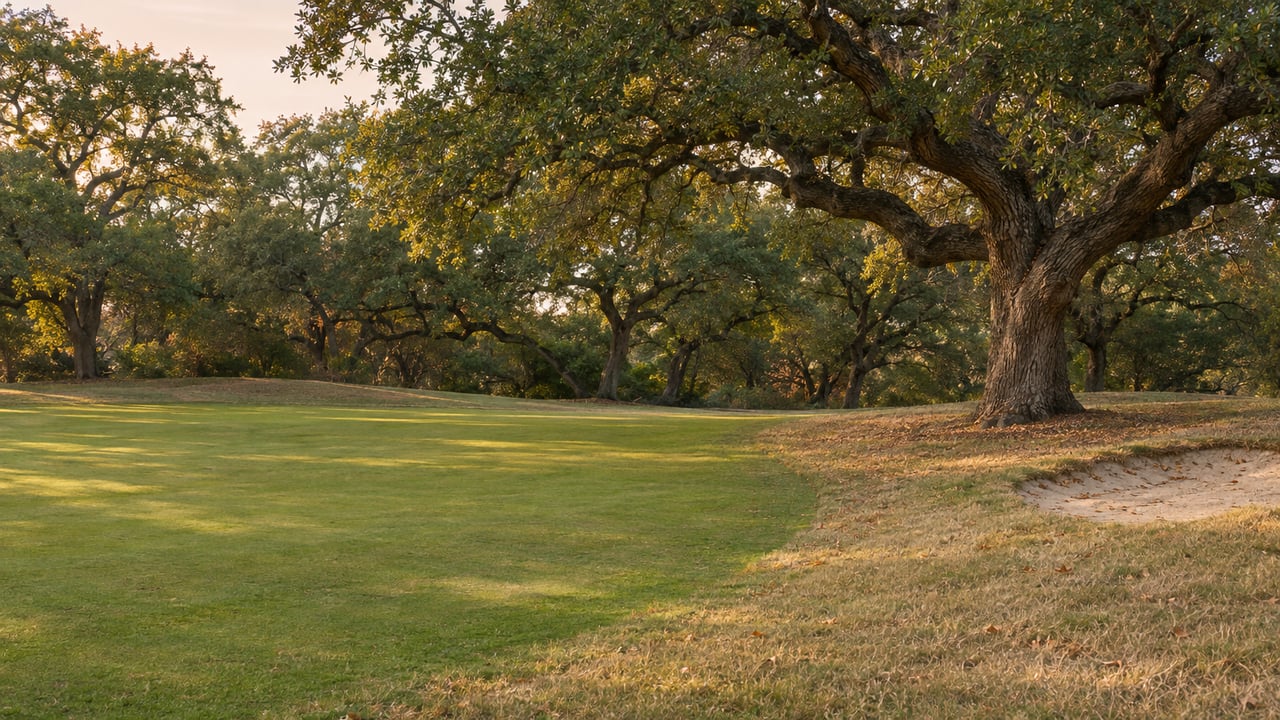
Lions Municipal Golf Course has been part of West Austin for more than a century. For the last seven of those years, the city has held it on a month-to-month lease. The land is owned by The University of Texas at Austin. According to the Austin American-Statesman, the city's lease on the 141-acre property expired in 2019 and has renewed month to month ever since. A course that has hosted Ben Hogan, Byron Nelson, Sandra Haynie, Tom Kite and Ben Crenshaw has spent those years on a renter's footing.
City staff set Nov. 19, 2026, as the date to bring a proposed fix to City Council. The UT System Board of Regents also has a regular meeting scheduled for Nov. 18 and 19. For anyone who lives along Enfield Road, Lake Austin Boulevard or the streets of Tarrytown and Pemberton, the proposal does two things at once. It would make the golf course permanent city property, and it would write the rules for what UT can build on the land around it.
A course built on borrowed ground
Muny began with a lease. In 1924, the Lions Club leased part of UT's Brackenridge Tract and turned it into a nine-hole course, Austin's first public golf course. It later grew to 18 holes, and the "Lions Municipal" name stayed after the city took over the lease in the 1930s. The Muny Conservancy dates the clubhouse to 1930.
That borrowed ground is also where Muny made national history. The Conservancy's account says two young Black golfers were allowed to finish their round in late 1950 after Mayor Taylor Glass consulted with council members. The city describes Muny as the first public golf course in the South to integrate, years before Brown v. Board of Education. In 2016 the course was listed on the National Register of Historic Places as a civil rights landmark. Today the city calls it Austin's most used public course, with more than 75,000 rounds played each year among its heritage trees.
The land itself traces to George W. Brackenridge, who gave about 500 acres to the university "for the benefit of The University of Texas," as the Statesman put it. That gift includes the golf course and the West Austin parcels that now hold the new H-E-B, CVS and Mozart's. Since 1989, the Brackenridge Development Agreement between the city and UT has governed how the university may use its land on both sides of Lake Austin Boulevard.
What Council takes up this week
The city announced the proposal on Oct. 14, 2026. It would amend the 1989 agreement and transfer ownership of Muny to the City of Austin. Anonymous donors made the purchase possible. The Statesman reported "very large" gifts and said the amounts were not disclosed. Mayor Kirk Watson told the paper, "This is intended to preserve Muny forever."
The package covers more than the golf course. According to the city's announcement, the amendments also lay out the general process for:
- updating the university's lease at Mueller,
- exchanging city rights-of-way,
- creating a Tax Increment Reinvestment Zone, or TIRZ, and
- developing a regulating plan that both parties agree on.
The Statesman also reported that the fields and gym used by the West Austin Youth Association would transfer to that organization.
The timeline has three steps. City staff scheduled the amended agreement for Council on Nov. 19. UT's regents must approve the land transfers. The regulating plan and the TIRZ would go through boards, commissions and Council in spring 2027. As of this week, the transfer is a proposal and not a completed sale.
The city's reason for taking this route came out at the Oct. 21 Environmental Commission briefing. Austin Current reported that commissioners asked why the process was moving so quickly. Trish Link, an attorney in the city's law department, said the city could not afford to buy the course outright. "We're exchanging what we actually have," she said, "rather than the price tag that we cannot afford in cash." In other words, the city would secure the golf course partly by agreeing to development rules for the rest of the tract.
The rules proposed for the land next door
This is the part that reaches past the golf course. Planning Commission briefing materials from Oct. 27, 2026, summarize the proposed standards for non-UT projects on the remaining Brackenridge land. The city keeps background on the agreement on its Brackenridge Tract page.
| Standard | Proposed terms |
|---|---|
| Area covered | 190.26 acres |
| Overall floor-area ratio | 0.6:1 across the entire area |
| Per-site cap | Individual sites may exceed 0.6:1, but no site may exceed 5:1 unless Council approves an increase through the rezoning process |
| Height next to and north of Lake Austin Boulevard | 65 feet maximum, subject to the code's height-limit exception |
| Height south of the boulevard, not next to it | Up to 105 feet, subject to the same exception |
| Impervious cover | 75% overall; up to 85% on an individual site |
The same materials say compatibility requirements apply north of Lake Austin Boulevard. The TIRZ would follow the city's affordable-housing policy, though the affordable housing would not have to be built inside the TIRZ area. Austin Current reported that the current agreement requires the city to pay for water, sewer and other infrastructure on the tract. The TIRZ would cover those costs through taxes on non-university development.
The Statesman reported that UT has no development plans for its other properties yet. Neighbors have spoken up on both sides of the question. Ken Tiemann, chair of the Save Historic Muny District, told the Statesman the plan was "a miracle." At the Environmental Commission, Holly Reed of The Muny Conservancy board and the West Austin Neighborhood Group said the neighborhood was excited about saving Muny. She also said, "We need more information from the university and the city on how the proposed new development will impact traffic and the environment," according to Austin Current. Researchers from UT's Brackenridge Field Lab, which sits on land the new agreement would govern, described a site home to 700 plant species and 160 bird species.
The terms above come from city briefing materials and are still a proposal. This is general information, not legal advice. Owners who want to know how the standards could affect a specific property should check with a land-use attorney.
How to play it, or just see it, now
Until ownership changes, Muny runs as it has for years, as a public city course managed by Golf ATX. The rules for getting a tee time favor anyone who plans ahead. Here is how booking works, according to the city's Lions Municipal page:
- Weekdays: Online booking opens at 9 a.m., seven days ahead. You can also reserve in person when the pro shop opens, or by phone at (512) 978-6869, starting 30 minutes before the first tee time.
- Weekends: Saturday and Sunday times open online only at 8 p.m. the Monday before. The pro shop phones pick up on Tuesday.
- Accounts: You need a user account to book online, so create one before Monday night.
Weekend booking has been online only since Oct. 27, 2025. Evening and sunset round times change through the year, and green fees are posted on the city's fees and memberships page.
A few practical details from the same city page:
- Closures: The course closes for maintenance on the third Monday of each month, except holidays and major tournaments.
- Practice: The driving range is irons only, and it closes at 1 p.m. on Mondays until further notice. A small bucket of range balls costs $7 and a large bucket costs $10.
- Payment: Cards only, no cash.
- Non-golfers: A friend who doesn't play can ride along in a cart. The city lists no fee for children 12 and under and $10 for anyone 13 and up, pets included.
Cisco's Muny Cafe serves the course and can be reached at 512-542-9459. The Statesman reported at its 2021 launch that the cafe is tied to the East Austin Cisco's, with a similar menu, and that the operation is led in part by a grandson of founder Rudy "Cisco" Cisneros. Call ahead for current hours.
July is Muny's big month. The city calls the Firecracker Open Texas' oldest amateur tournament. The Conservancy says it has been held at Muny every July since 1945, and the 2026 edition ran July 3 through 5.
What preservation could make possible
Ownership is the first step. The Muny Conservancy has described future plans, contingent on preservation, that include a course restoration with Coore & Crenshaw and a teaching center honoring Muny's integration history. It has also floated an education center, a golf museum and a history collection. Tiemann told the Statesman he hopes the land can host field trips and education. None of this has been approved yet. Council's Nov. 19 action and the regents' vote come first, followed by the spring 2027 work on the regulating plan and the TIRZ.
For West Austin homeowners, Muny's history and the rules for the tract around it both shape what living near Enfield Road is like. If you would like to talk through how the Brackenridge proposal might affect your home's setting, or how a 141-acre public green space figures into a property's value, Karen Kelly is glad to walk through it with you. Let's Connect.